

Beyond the Horizon: The Smithsonian National Air and Space Museum and America's Journey from Flight to the Stars (1776–2026)
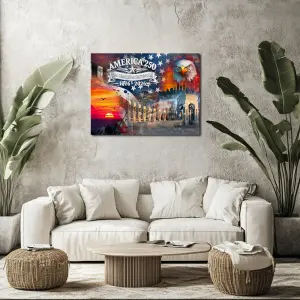
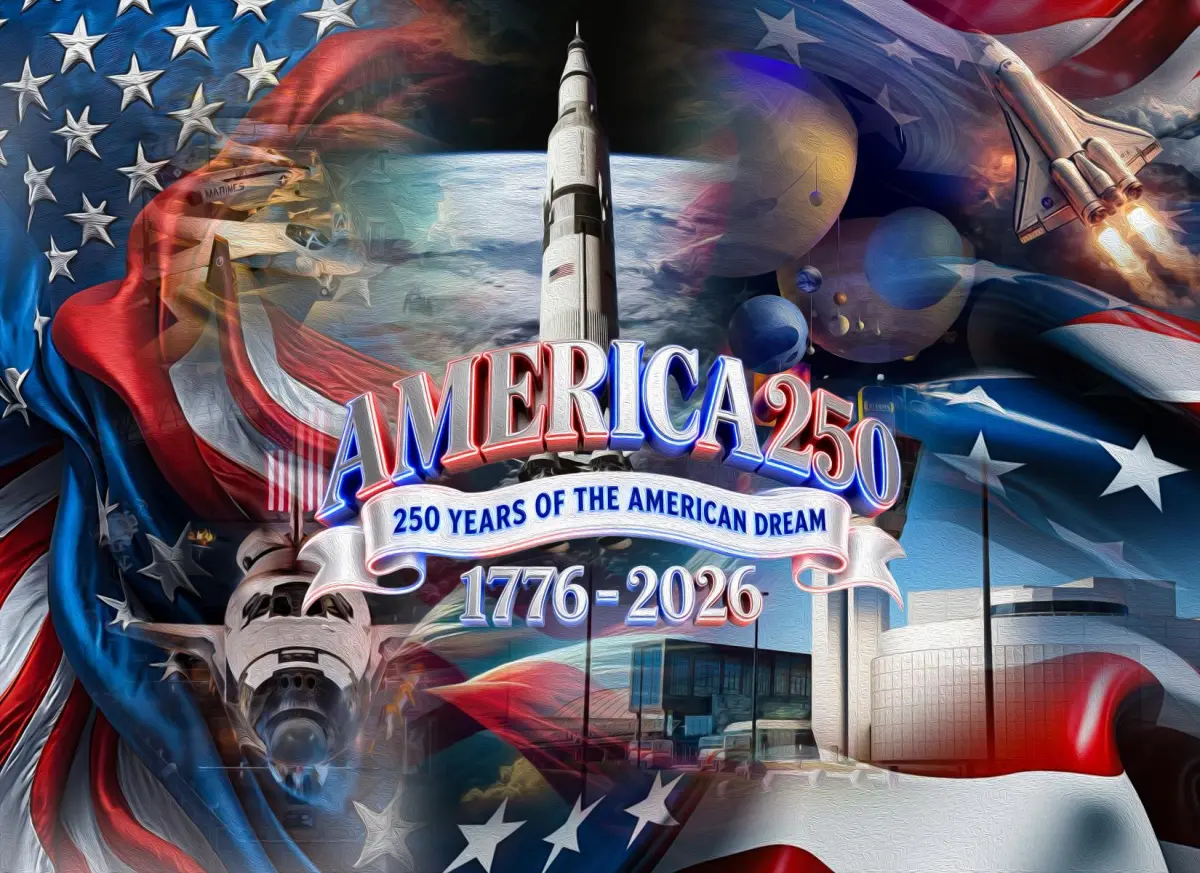
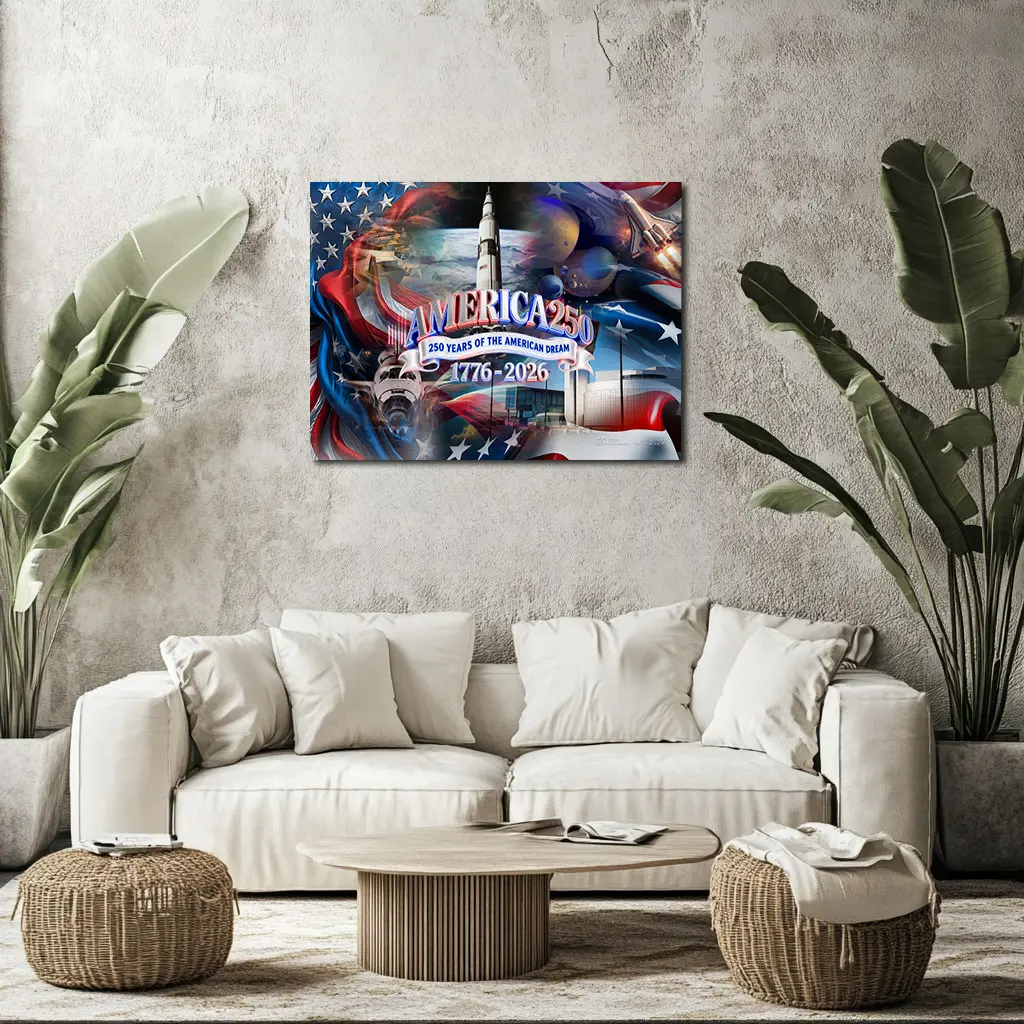
This artwork celebrates America's 250-year journey (1776–2026) through the inspiring symbolism of the Smithsonian National Air and Space Museum , the Saturn V rocket , the Space Shuttle , Earth , the planets , the American flag , and the America 250 emblem. The description naturally incorporates the history of NASA , the Apollo Moon missions , the Space Shuttle Program , and the Smithsonian museum's role in preserving the nation's aerospace heritage. Rich patriotic colors, luminous cosmic lighting, layered textures, and balanced composition create a compelling visual narrative of exploration, scientific achievement, innovation, and discovery. More than a celebration of aviation and spaceflight, the artwork honors the generations of pilots, engineers, astronauts, scientists, and dreamers whose curiosity transformed impossible ideas into historic achievements, affirming that the American dream has always been driven by the courage to look beyond the horizon and reach for the stars.
Please see Below for Details…


Hotline Order:
Mon - Fri: 07AM - 06PM
019-234-09789
When I created this artwork, I wanted to celebrate one of the most extraordinary chapters in the American story—the relentless desire to explore what lies beyond the horizon. From the earliest dream of human flight to walking on the Moon and exploring the vastness of space, America has continually pushed the boundaries of imagination and innovation. As the nation commemorates 250 years of independence (1776–2026), I wanted this composition to honor not only remarkable machines or scientific achievements, but the enduring spirit of curiosity that has always driven humanity to reach farther than anyone believed possible.
At the heart of the artwork stands the America 250 emblem bearing the words "250 Years of the American Dream." I chose this phrase because aviation and space exploration embody one of the most powerful expressions of that dream. The American journey has never been confined to the land where it began in 1776. It has continually expanded—from crossing mountains and oceans to breaking the sound barrier, orbiting the Earth, landing on the Moon, and exploring distant worlds. Every element in this composition reflects humanity's desire to transform imagination into reality.
Dominating the center of the artwork is the magnificent Saturn V rocket, one of the greatest engineering achievements in human history. Standing as a towering symbol of ambition, the Saturn V carried the Apollo missions into space, including Apollo 11, the mission that placed the first humans on the Moon on July 20, 1969. Developed under the leadership of NASA, which was established in 1958, the Saturn V remains the tallest, heaviest, and most powerful rocket ever successfully flown into regular service. I positioned it at the center because it represents more than technological achievement—it symbolizes humanity's willingness to pursue what once seemed impossible.
Behind the rocket stretches the breathtaking view of Earth, suspended against the darkness of space. I wanted our planet to become a quiet reminder of perspective. Looking back at Earth from space forever changed humanity's understanding of itself. National borders disappear, and what remains is one shared home. Including Earth reflects one of the greatest gifts of space exploration—not only discovering new worlds, but learning to appreciate our own.
Surrounding Earth are distant planets, representing the expanding frontier of exploration. These celestial bodies symbolize America's continuing scientific missions, from robotic explorers sent to Mars, Jupiter, and Saturn to powerful observatories studying the origins of the universe. Rather than portraying space as empty darkness, I wanted it to feel alive with possibility, reminding viewers that every discovery answers one question while inspiring countless others.
To the upper right, a Space Shuttle ascends dramatically toward orbit. The Space Shuttle Program, operating from 1981 to 2011, transformed human spaceflight by creating the world's first reusable orbital spacecraft. The shuttle launched satellites, carried astronauts into orbit, helped construct the International Space Station, and expanded scientific research beyond Earth's atmosphere. Its powerful ascent represents innovation built upon the achievements of earlier generations, proving that exploration is always a continuing journey rather than a final destination.
Emerging from the lower left is another iconic spacecraft—the Space Shuttle orbiter returning through the composition with its distinctive silhouette. I wanted to include both launch and return because exploration is defined not only by reaching new frontiers but also by bringing knowledge home. Every mission expands humanity's understanding of science, engineering, medicine, communication, and the universe itself.
In the foreground stands the modern building of the Smithsonian National Air and Space Museum, one of the world's most visited museums and the guardian of America's aviation and space heritage. Opened on the National Mall in 1976, during the United States Bicentennial, the museum preserves some of history's most important aerospace artifacts. Within its galleries are the 1903 Wright Flyer, Charles Lindbergh's Spirit of St. Louis, the Apollo 11 Command Module Columbia, space capsules, satellites, lunar artifacts, and countless aircraft that transformed transportation and exploration. I wanted the museum to anchor the composition because it represents the preservation of knowledge. Every generation builds upon the discoveries of those who came before.
Flowing around every element is the American flag, whose stars and stripes become both a visual and symbolic bridge between Earth's history and humanity's future. The thirteen stripes recall the original colonies that declared independence in 1776, while the fifty stars represent the Union that would later become one of the world's leading centers of scientific innovation. I allowed the flag to wrap around rockets, spacecraft, and the museum because exploration itself has become part of America's national identity.
Color became one of my most expressive artistic tools. Rich crimson reflects courage—the willingness to attempt what had never been accomplished before. Deep blue symbolizes knowledge, trust, and the vastness of both the sky and space. Brilliant white conveys hope, scientific discovery, and the optimism that fuels innovation. Warm gold surrounding Earth represents the shared future of humanity, while vibrant blues, violets, and cosmic purples fill the universe with wonder and infinite possibility. Every color transition reflects humanity's journey from the familiar world beneath our feet to the mysteries waiting beyond our atmosphere.
Lighting plays an essential role throughout the artwork. The Saturn V rises through brilliant illumination, symbolizing the dawn of a new era in exploration. Sunlight reflects gently across Earth, emphasizing both its beauty and fragility. The glow surrounding the planets creates a sense of mystery, while the fiery exhaust of the ascending Space Shuttle captures the tremendous energy required to overcome gravity. I wanted every source of light to represent knowledge—each discovery illuminating another small corner of the unknown.
Texture adds richness and realism throughout the composition. The polished metal surfaces of rockets and spacecraft contrast beautifully with the flowing fabric of the American flag. The smooth curves of Earth and the planets introduce softness against the precise engineering of aerospace technology. The modern glass architecture of the Smithsonian museum reflects innovation and transparency, while the stars scattered throughout the composition provide depth and a sense of infinite scale.
Compositionally, every visual element draws the eye upward. The vertical ascent of the Saturn V creates a powerful axis that connects Earth with space. The Space Shuttle reinforces this movement, while the flowing American flag guides the viewer naturally across the composition. Earth becomes the emotional center, reminding us that every journey into space begins with home. The balanced arrangement between technology, history, and the cosmos reflects the harmony between scientific achievement and human imagination.
Artistically, I blended symbolic realism with contemporary digital collage to unite multiple eras of aviation and space exploration within one cohesive vision. Rather than illustrating a single mission, I layered iconic spacecraft, celestial imagery, national symbols, and the Smithsonian museum into one visual narrative spanning more than a century of innovation. Painterly textures, cinematic lighting, luminous colors, and detailed aerospace imagery transform familiar achievements into a timeless celebration of exploration.
The atmosphere is inspiring, visionary, and deeply optimistic. I did not want this artwork to focus solely on technological achievement. Instead, I wanted it to celebrate human curiosity itself. Every aircraft, rocket, satellite, astronaut, engineer, scientist, technician, educator, and dreamer represented here contributed to one remarkable truth—that the limits of yesterday often become the starting point for tomorrow.
Every symbol carries profound historical significance. The Smithsonian National Air and Space Museum preserves the story of aviation and space exploration for future generations. The Saturn V rocket represents the Apollo Program and humanity's first steps on the Moon. The Space Shuttle symbolizes reusable spaceflight, scientific discovery, and international cooperation. Earth reminds us of the fragile world that exploration has taught us to cherish. The planets represent humanity's continuing search for knowledge throughout the Solar System. The American flag reflects the ideals of freedom, innovation, and perseverance that inspired generations of explorers. Finally, the America 250 emblem connects these extraordinary achievements to the nation's broader story—a republic founded on bold ideas that eventually reached beyond the atmosphere itself.
As the artist, I wanted viewers to understand that the history of American aviation and space exploration is ultimately a history of human imagination. Every successful flight began as an impossible dream. Every spacecraft launched because someone believed that curiosity was stronger than fear. Every museum artifact reminds us that today's achievements become tomorrow's inspiration.
Ultimately, "Beyond the Horizon: The Smithsonian National Air and Space Museum and America's Journey from Flight to the Stars (1776–2026)" is my tribute to the explorers, inventors, engineers, astronauts, scientists, educators, and visionaries whose determination transformed the sky from a limit into a gateway. It celebrates 250 years of American innovation while reminding us that the greatest frontier has never been a destination—it is the endless human desire to discover, to understand, and to continue reaching for the stars.
Add your review
Your email address will not be published. Required fields are marked *
Please login to write review!
Looks like there are no reviews yet.