


A Generation's Greatest Victory: The National World War II Memorial and America's Legacy of Courage (1776–2026)
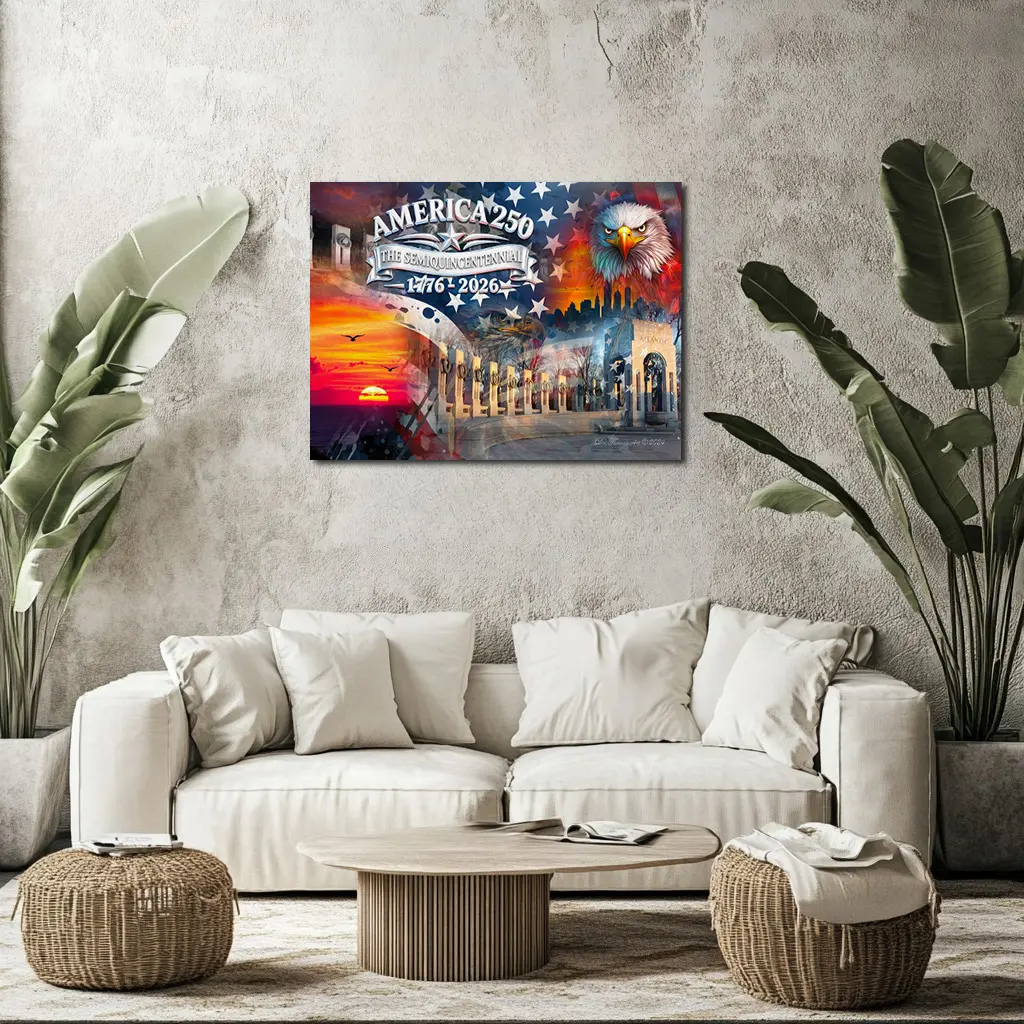
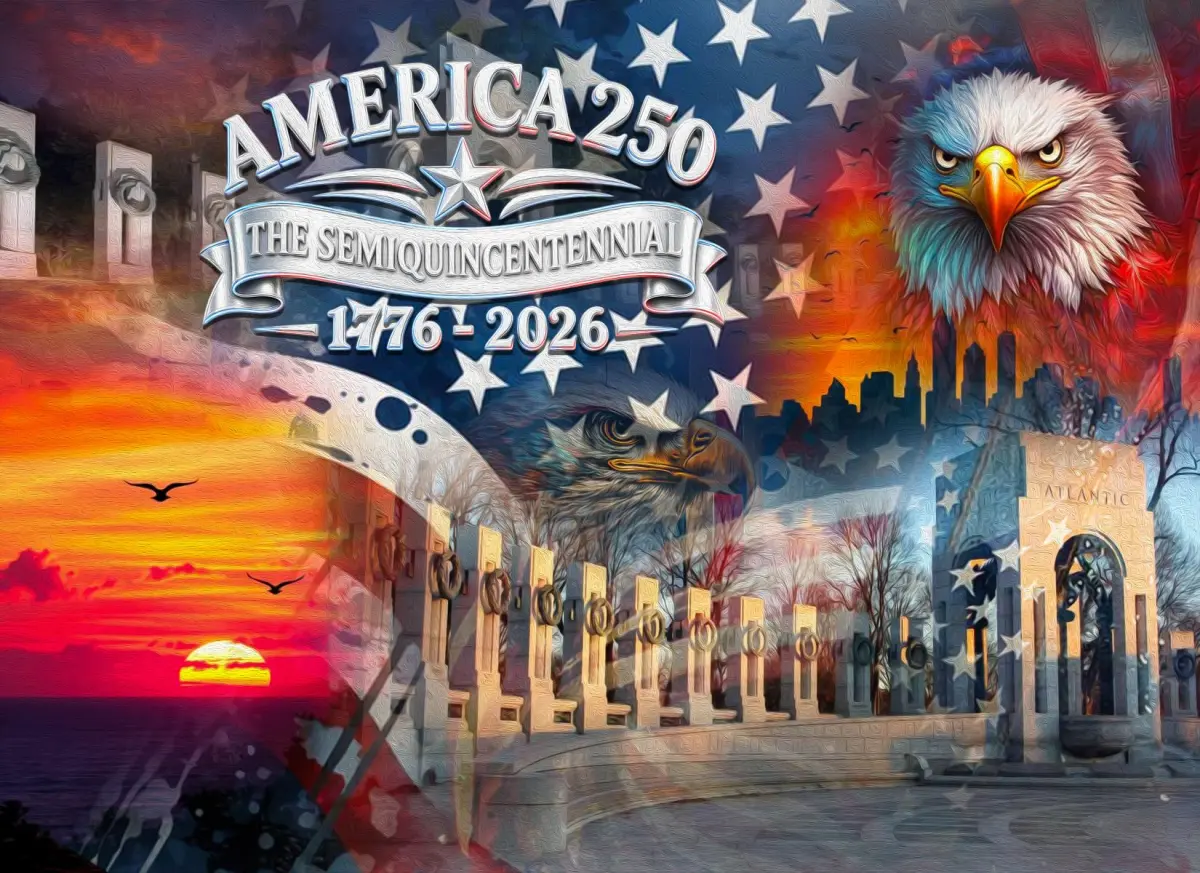
This artwork commemorates America's 250-year journey (1776–2026) through the powerful symbolism of the National World War II Memorial , its 56 granite pillars , the Atlantic Arch , the American flag , the bald eagle , and a radiant sunrise representing peace after conflict. The description naturally incorporates the memorial's history, its dedication in 2004, its tribute to the 16 million Americans who served during World War II, and the significance of its architectural elements. Rich patriotic colors, luminous lighting, layered textures, and balanced composition create a moving visual narrative celebrating unity, courage, sacrifice, and renewal. Rather than glorifying war, the artwork honors The Greatest Generation and their enduring legacy, reminding viewers that the freedoms celebrated during America's Semiquincentennial were preserved through the selfless service of those who defended democracy during one of history's most defining moments.
Please see Below for Details…


Hotline Order:
Mon - Fri: 07AM - 06PM
019-234-09789
When I created this artwork, I wanted to honor a generation that forever changed the course of history. America's story has been shaped by many defining moments, but few tested the nation's resolve as profoundly as the Second World War. As the United States celebrates 250 years of independence (1776–2026), I felt it was essential to dedicate one piece to the men and women whose courage extended beyond the defense of their own country to the defense of freedom itself. This artwork is my tribute to the generation often remembered as "The Greatest Generation," whose sacrifice helped preserve liberty for millions around the world.
At the heart of the composition stands the National World War II Memorial, quietly illuminated beneath the stars and stripes. I chose this memorial because it represents not a single battle or military campaign, but the collective effort of an entire nation. Dedicated on May 29, 2004, on the National Mall in Washington, D.C., the memorial honors the 16 million Americans who served in the Armed Forces during World War II, the millions more who supported the war effort on the home front, and the more than 400,000 Americans who gave their lives during the conflict. It stands as one of the nation's most powerful places of remembrance, where victory is remembered with gratitude rather than triumphalism.
The graceful semicircle of granite pillars forms the architectural centerpiece of the memorial. There are 56 pillars, each representing the 48 states, the District of Columbia, and the seven U.S. territories that existed during the war. I wanted these pillars to symbolize more than geography. Standing together in a continuous circle, they reflect unity across an entire nation that set aside differences to confront one of history's greatest threats. Their shared design suggests that strength comes not from standing alone, but from standing together.
On the right side of the composition rises the memorial's iconic Atlantic Arch, one of two triumphal arches that frame the site. Opposite it, though partially beyond the composition, is the Pacific Arch, together representing the two great theaters in which American forces fought during the war. I intentionally emphasized the Atlantic Arch because it immediately evokes the liberation of Europe while quietly reminding viewers that World War II demanded sacrifice across oceans, continents, and cultures. These arches stand as gateways between memory and gratitude, honoring every branch of military service that answered the call.
Flowing across the artwork is the American flag, wrapping the memorial within the nation's enduring colors. The thirteen stripes recall the republic born in 1776, while the fifty stars represent the Union whose freedoms were defended nearly two centuries later. I wanted the flag to move naturally through the composition, suggesting that the ideals established by the Founding Fathers continued to inspire those who fought during World War II. Liberty is not confined to one era; it passes from one generation to the next.
Watching over the memorial is the majestic bald eagle, whose piercing gaze reflects vigilance, resilience, and hope. Officially adopted as the national emblem in 1782, the bald eagle has long symbolized the spirit of the United States. Here, I chose to portray the eagle with quiet confidence rather than aggressive power. To me, the greatest victories are those achieved not through domination, but through courage guided by purpose. Its presence reminds us that the freedoms defended during World War II remain a responsibility entrusted to every generation.
The skyline rising in the distance represents modern America—a nation transformed by the sacrifices of those who came before. The peaceful cityscape stands in deliberate contrast to the hardships of war. Every illuminated building, every family gathered in safety, every opportunity enjoyed in freedom exists because previous generations accepted extraordinary burdens in moments of global crisis. I wanted the skyline to symbolize the future those veterans fought to protect rather than the war they endured.
To the left, a radiant sunrise spreads across the horizon, filling the composition with warm golden light. I chose the rising sun as a symbol of renewal. After years of conflict, destruction, and unimaginable loss, the conclusion of World War II offered hope for rebuilding nations, restoring peace, and creating new international partnerships. The sunrise reminds viewers that even history's darkest chapters can give way to a brighter future when courage is matched by compassion and determination.
The America 250 emblem occupies the upper center of the composition, bearing the words "The Semiquincentennial 1776–2026." I wanted this commemorative emblem to unite the nation's revolutionary beginnings with one of its defining moments on the global stage. America's first 250 years have been shaped not only by independence but also by the willingness of its citizens to defend democratic ideals wherever they have been threatened.
Color became the emotional language of this artwork. Deep crimson reflects sacrifice and the courage displayed across battlefields, oceans, skies, and home front communities. Rich blues symbolize loyalty, perseverance, and the enduring strength of democratic institutions. Brilliant whites echo the memorial's granite architecture, expressing honor, integrity, and the hope that emerged from victory. Warm gold surrounding the sunrise represents renewal and gratitude, while subtle purples within the evening sky acknowledge the solemn memory of lives forever changed by war.
Lighting flows gently across the composition. The memorial itself is illuminated with quiet dignity rather than dramatic intensity because remembrance deserves reverence. Soft sunlight breaks across the horizon, gradually reaching the pillars before spreading toward the eagle and the flag. I wanted this progression of light to symbolize the return of peace after years of global conflict. Gentle highlights across the stone architecture reveal permanence, while long shadows remind us that every victory carries the memory of sacrifice.
Texture adds depth and authenticity throughout the composition. The polished granite of the memorial contrasts beautifully with the flowing fabric of the American flag and the intricate feathers of the bald eagle. The reflective stone surfaces capture changing light, suggesting that memory itself evolves with each generation. The warm glow of the sunrise softens the architectural forms, creating a balance between permanence and hope.
Compositionally, every element guides the viewer toward the National World War II Memorial before allowing the eye to travel naturally across the Atlantic Arch, the skyline, the eagle, and the flag. The circular rhythm created by the memorial's pillars reinforces themes of unity and continuity, while the vertical arch and sweeping horizon introduce both strength and openness. Together they create a harmonious visual journey from remembrance toward renewal.
Artistically, I combined symbolic realism with contemporary digital collage to unite history, architecture, and patriotic symbolism into one cohesive narrative. Rather than illustrating a specific battle, I wanted to capture the larger legacy of World War II—the resilience of ordinary citizens, the determination of Allied forces, and the enduring commitment to democratic ideals. Layered imagery, painterly textures, luminous color grading, and cinematic lighting transform familiar national symbols into a timeless reflection on courage and remembrance.
The atmosphere is reverent, hopeful, and quietly triumphant. This is not a celebration of war. It is a celebration of the human spirit that refused to surrender to tyranny, oppression, and fear. Every element of the composition was chosen to honor service while emphasizing the peace that courageous service ultimately made possible.
Every symbol carries its own historical significance. The National World War II Memorial commemorates all Americans who served during the conflict and the nation they defended. The 56 granite pillars represent the unity of every state and territory during the war years. The Atlantic Arch honors those who served in the European Theater, while its companion Pacific Arch represents the Pacific campaign. The American flag reflects the enduring ideals first declared in 1776. The bald eagle symbolizes vigilance, freedom, and resilience. The sunrise expresses renewal after hardship, and the America 250 emblem connects the nation's revolutionary origins with one of its defining moments of global leadership and sacrifice.
As the artist, I wanted viewers to understand that the National World War II Memorial is more than a monument to victory. It is a place where gratitude becomes visible. Every pillar, every inscription, and every quiet reflection honors individuals who answered history's call with extraordinary courage. Their legacy is measured not only by the wars they fought, but by the peace they helped secure for generations that followed.
Ultimately, "A Generation's Greatest Victory: The National World War II Memorial and America's Legacy of Courage (1776–2026)" is my tribute to those whose service protected the ideals of liberty during one of humanity's darkest hours. It celebrates 250 years of American freedom while reminding us that democracy, peace, and human dignity are never guaranteed. They endure because generations of ordinary people have been willing to make extraordinary sacrifices so that the light of freedom would continue to shine for those who came after them.
Add your review
Your email address will not be published. Required fields are marked *
Please login to write review!
Looks like there are no reviews yet.