
Torque, Titanium and the Tipping Point Ilia Malinins Measured Fire Within Team USAs Olympic Gold at Milano Cortina
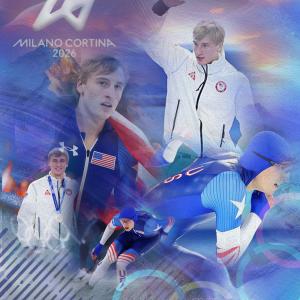
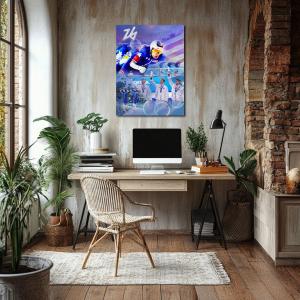
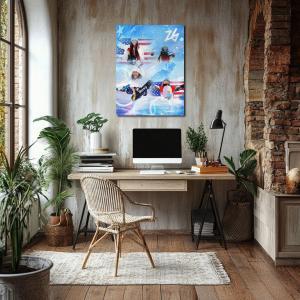
At the Milano Cortina 2026 Winter Olympics, Ilia Malinin delivered 98.00 (TES 52.62 / PCS 45.38) in the Team Short Program and 200.03 (TES 110.32 / PCS 89.71) in the Team Free Skate, earning 9 + 10 placement points and helping Team USA secure 69 total points and Olympic Gold . In the Individual Event, he scored 108.16 in the Short Program and 156.33 (−2.00 deductions) in the Free Skate , for a 264.49 combined total , placing 8th overall . The artwork translates these verified ISU protocol numbers into cobalt precision, titanium torque, and golden collective triumph — a portrait of measurable fire on Olympic ice.
Please see Below for Details…


Hotline Order:
Mon - Fri: 07AM - 06PM
019-234-09789
Inside the calibrated light of the Milano Ice Skating Arena during the XXV Olympic Winter Games — Milano Cortina 2026, Ilia Malinin carved a numerical architecture that exists simultaneously as ice trace and archival permanence. This artwork, as I construct it, does not merely celebrate motion; it translates verified Olympic protocol into chromatic structure. Every rotation here is recorded, every landing preserved in official judges’ detail sheets, every placement point embedded in the arithmetic that crowned Team USA with Olympic Gold in the Figure Skating Team Event.
Begin with the Team Event — the framework of eight segments where medal color is determined strictly by placement-point accumulation. In the Men’s Short Program segment, Malinin scored 98.00 points, composed of Technical Element Score (TES) 52.62, Program Component Score (PCS) 45.38, and Deductions 0.00. That performance secured 2nd place in the segment, converting into 9 placement points for Team USA. The mathematics here is not interpretive — it is definitive. Under Olympic Team Event rules, first place earns 10 points, second earns 9, third earns 8, descending accordingly. Those 9 points became part of a cumulative ledger that would eventually total 69 points for the United States — the gold-medal-winning aggregate.
Then came the fulcrum.
In the Men’s Team Event Free Skate, Malinin delivered 200.03 points, comprised of TES 110.32, PCS 89.71, and Deductions 0.00. The 200.03 secured 1st place in the segment, yielding the maximum 10 placement points. Numerically, this segment alone accounts for 12.5% of the theoretical 80-point team maximum. Contextually, it functioned as the tipping mechanism: Team USA concluded the Team Event with 69 total placement points, edging Japan’s 68 by a single point. Remove Malinin’s 10-point first-place finish in the Free Skate, and the gold-medal equation fractures. That is not metaphor — it is protocol arithmetic.
Render it in titanium-gold — not decorative gold, but engineered gold, reflective and structural. The 110.32 TES is metallic, forged in rotational velocity and quad construction. It represents jump content of the highest base value strata — quadruple rotations whose conservation of angular momentum demands both explosive takeoff and compressed rotational axis. TES is blade and bone; it is torque translated into tabulation. The 89.71 PCS is warmer — amber, rose-gold, diffused arena light — reflecting skating skills, transitions, performance, composition, interpretation. Where TES is steel, PCS is breath.
The absence of deductions (0.00) in both Team segments is critical. Zero is not emptiness — it is structural integrity. In your composition, zero is rendered as uninterrupted ice — smooth cerulean planes, no fracture, no scarlet rupture.
Now shift to the Individual Men’s Event — a separate ledger, separate destiny.
In the Individual Short Program, Malinin scored 108.16, constructed from TES 62.35, PCS 45.81, and Deductions 0.00. The 108.16 placed him among the leaders entering the Free Skate. The TES of 62.35 reflects ultra-high technical ambition; PCS 45.81 indicates compositional maturity. In your palette, this is electric cobalt — sharp, luminous, vertical.
Then the Individual Free Skate.
Official protocol confirms: 156.33 total, comprised of TES 76.61, PCS 81.72, and Deductions −2.00. Two falls resulted in two separate −1.00 deductions under ISU regulations. The deductions are not symbolic — they are explicit. The combined total for the Individual Event became:
108.16 (SP) + 156.33 (FS) = 264.49
Final Olympic Placement: 8th overall.
Individual Medal Color: None.
In this arithmetic lies duality.
The 76.61 TES still confirms technical density — the ambition did not vanish. The 81.72 PCS demonstrates sustained interpretive strength. But the −2.00 deductions altered placement trajectory. Two points in Olympic figure skating is not cosmetic; it is structural. Those deductions shifted cumulative ranking and placed Malinin eighth.
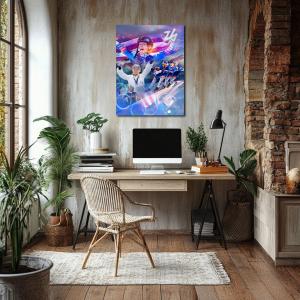
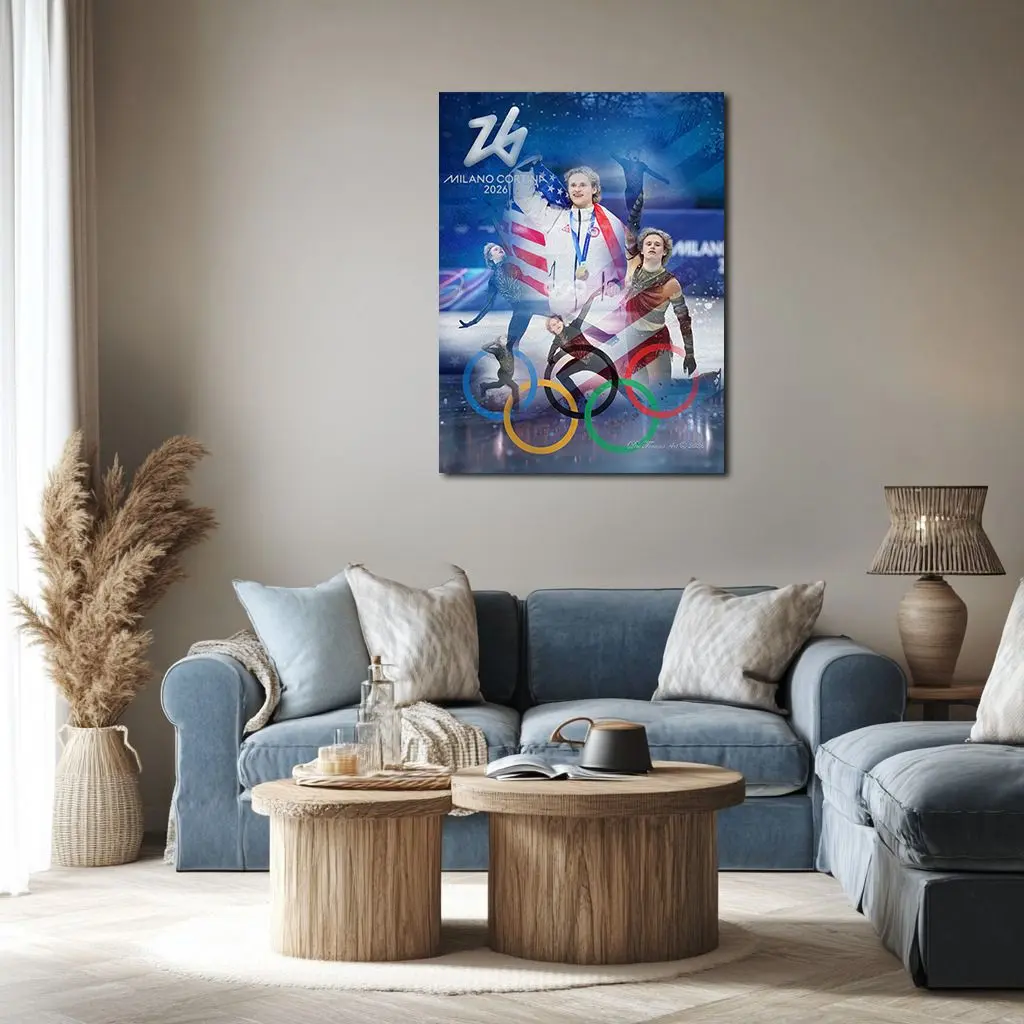
The Team Event field is rendered in ascending gold light — the American flag behind him luminous, the medal reflecting warm spectrum tones. The Individual field introduces indigo and shadowed blue — not defeat, but gravity. Indigo symbolizes the thin numerical margin between podium and placement. The Olympic rings beneath him are not decorative; they are concentric scoring systems — TES orbiting PCS, deductions intersecting total, placement converting to permanence.
Notice the compositional geometry in this image: upward diagonals from lower left to upper right mirror the Team Event’s numeric ascent — 98.00 → 200.03 → 69 placement points → Gold. Meanwhile, the lower arc where he kneels and extends outward reflects the Individual arc — 108.16 → 156.33 → 264.49 → 8th.
Blue dominates the background — Olympic ice maintained near −5°C, where blade penetration must balance hardness and glide. Blue here is clarity. White overlays evoke score sheets — the clinical objectivity of ISU judging. Red accents represent anaerobic ignition, muscular combustion during quad takeoff. Gold occupies only the Team crown — disciplined, earned, mathematically secured.
Technically, angular momentum is conserved when arms compress; visually, your painting compresses data into gesture. A quadruple jump requires rotational velocity exceeding five revolutions per second. That physics becomes 110.32 TES in the Team Free Skate. The judges’ panel does not score emotion; it scores execution. Yet emotion survives in PCS. That tension — between measurable and felt — defines this Olympic portrait.
The Team Event equation is unambiguous:
Short Program: 98.00 → 9 placement points
Free Skate: 200.03 → 10 placement points
Total Team USA: 69 placement points → Olympic Gold
The Individual equation is equally exact:
Short Program: 108.16
Free Skate: 156.33 (−2.00 deductions)
Combined: 264.49 → 8th place
These numbers are immutable in Olympic archive. They are not narrative embellishment; they are recorded fact from ISU Judges’ Details per Skater protocols and official Milano Cortina results.
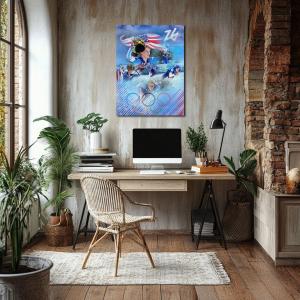
In my art, Malinin stands wrapped in the American flag — that is Team Event triumph. Yet around him orbit his other selves: airborne, extended, mid-spin. Those fragments represent the segmented scoring sheets. Each pose is a column in the protocol. Each blade mark is a GOE margin.
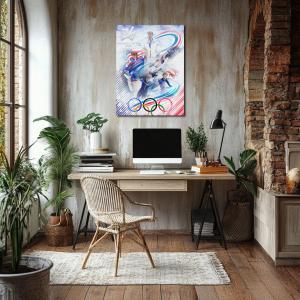
The lighting is deliberate: upper field gold for collective victory; lower field sapphire for individual reckoning. The Olympic rings glow beneath like scoring circles — red for execution, blue for skill, green for transitions, yellow for composition, black for placement.
Ultimately, this is not a painting about medals alone. It is a painting about arithmetic under pressure. About how 200.03 can tilt a nation to gold, and how −2.00 can tilt an individual from podium contention to eighth. It is about torque and tally. Fire and formula.
The music resolved.
The judges entered numbers.
The totals locked.
And within the frozen syntax of Milano Cortina 2026, Ilia Malinin became both vector and variable — Olympic Team Gold medalist, Individual 8th place finisher — his legacy written in cobalt, titanium, amber, and exact numerical truth.
Add your review
Your email address will not be published. Required fields are marked *
Please login to write review!
Looks like there are no reviews yet.