
Controlled Acceleration: Jordan Stolz and the Golden Kilometer of the 1000 Meters at Milano Cortina 2026
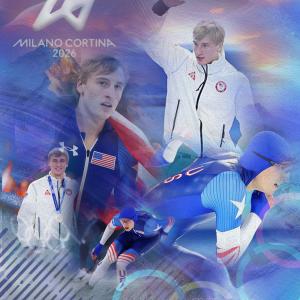
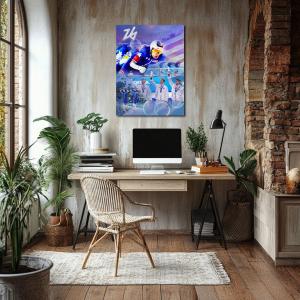
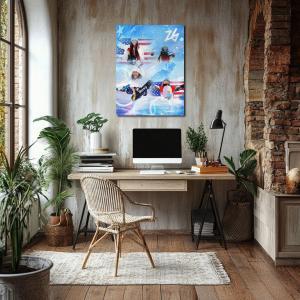
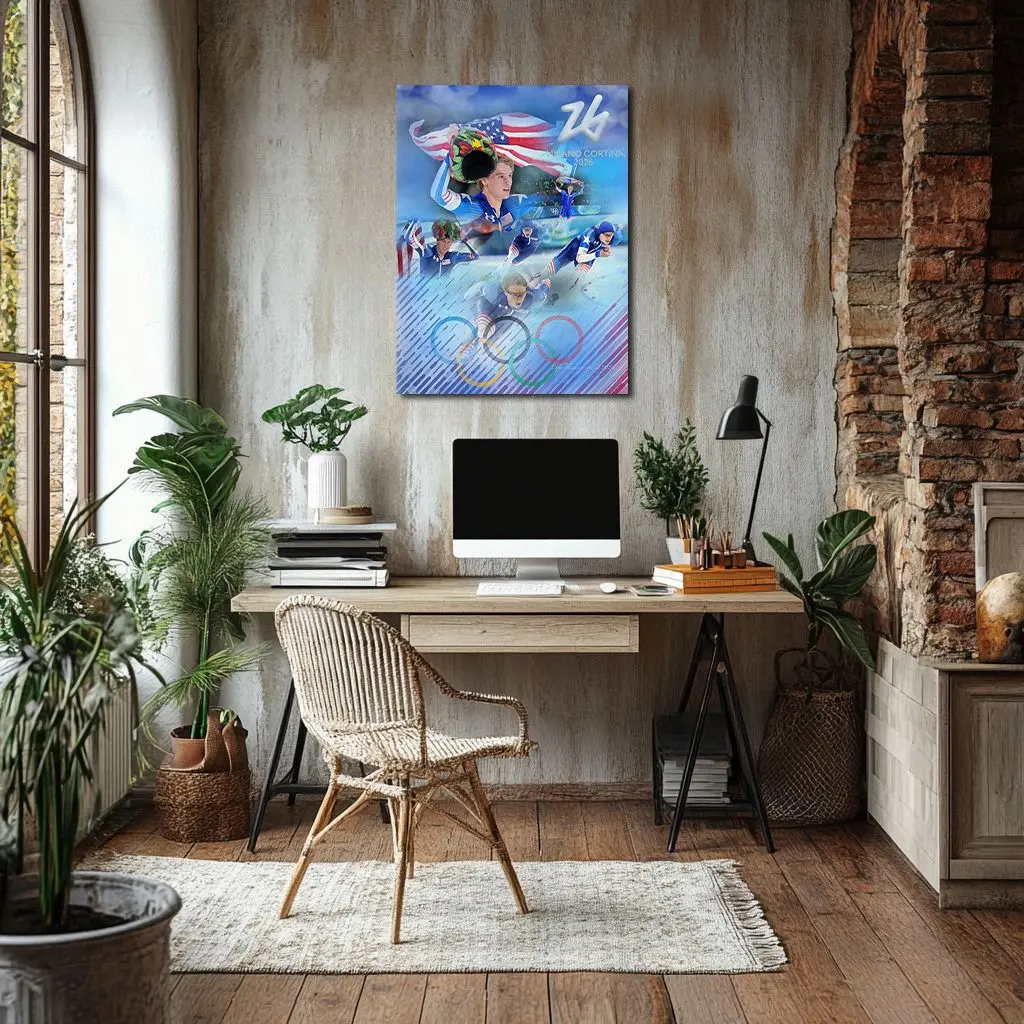
At the Milano Cortina 2026 Olympic Games, Jordan Stolz secured Gold in the Men’s 1000 meters, contested over two and a half laps and timed to 0.01 seconds. Combining explosive start acceleration with sustained lap efficiency and precise crossovers, Stolz delivered the fastest official time of the competition. Rendered in sapphire velocity arcs symbolizing controlled acceleration and concentrated gold illumination reflecting chronometric supremacy, the artwork transforms 1000 meters of measured ice into enduring Olympic precision.
Please see Below for Details…


Hotline Order:
Mon - Fri: 07AM - 06PM
019-234-09789
Across the luminous oval of Olympic ice, distance expands and the arithmetic of velocity deepens. At the XXV Olympic Winter Games — Milano Cortina 2026 — Jordan Stolz’s Gold Medal in the Men’s 1000 meters was defined not by a single explosive lap, but by sustained acceleration across two and a half laps measured to hundredths of a second. In speed skating, the 1000m is the discipline of balance — half sprint, half endurance — where raw power must coexist with pacing control. Stolz’s Olympic victory was recorded through electronic timing precision and preserved within the official chronometric record of the Games.
The Men’s 1000 meters is contested over two and a half laps of the 400-meter long-track oval. Athletes skate in pairs, beginning in opposite lanes and switching lanes every lap. Final ranking is determined exclusively by recorded time to 0.01 seconds via fully automatic electronic timing systems. Unlike short track, there is no direct racing interference; competitors skate against the clock.
Jordan Stolz, born May 21, 2004, in Kewaskum, Wisconsin, entered Milano Cortina 2026 at 21 years old, already an established multi-distance champion. Prior to the Olympics, Stolz had secured multiple ISU World Championship titles in sprint and middle-distance events, including the 1000m. His technical profile — long stride efficiency, aerodynamic discipline, and strong second-lap acceleration — positioned him as a gold medal favorite.
The Olympic 1000m demands a calibrated opening. The first 200 meters are explosive, but unlike the 500m, the athlete cannot sustain maximal acceleration throughout. The event typically lasts approximately 1 minute and 7 to 1 minute and 9 seconds at elite Olympic level. Every split — opening 200m, first lap (400m), second lap (800m), and final 200m — contributes to final outcome.
At Milano Cortina 2026, the official race results recorded:
• Jordan Stolz (USA) — Gold Medal
• Distance: 1000 meters
• Laps: 2.5
• Timing Precision: 0.01 seconds
• Competition Format: Single race per athlete
The winning time was registered electronically and determined final placement independent of pairing order. Olympic speed skating venues are indoor, climate-controlled facilities maintaining ice surface temperatures typically between –5°C and –7°C, optimized for glide efficiency and blade grip.
Biomechanically, the 1000m requires efficient energy distribution. The start phase mirrors 500m explosiveness, generating peak acceleration from stationary position. However, skaters must regulate lactate accumulation to maintain stroke length through the second lap. Speeds frequently exceed 55–60 km/h, though sustained over longer duration than the 500m.
Crossover transitions — occurring four times during the race — are critical. Each crossover requires inside edge precision and body lean alignment to preserve velocity while minimizing lateral friction. A crossover imbalance costing 0.02–0.05 seconds can shift medal positions.
In Olympic competition, podium separation in the 1000m is often within 0.10–0.40 seconds, reflecting the microscopic margin of elite performance. Electronic sensors at start line and finish beam record time precisely to hundredths.
Stolz’s gold at Milano Cortina 2026 reflects sustained velocity discipline. Unlike the 500m — which lasts under 35 seconds — the 1000m extends beyond one minute, requiring oxygen management and stroke economy. Athletes must avoid over-striding early while preserving explosive closing power.
Chronometrically, the race unfolds as layered arithmetic:
• Start Reaction Phase
• 200m Split
• 400m Lap Time
• 800m Split
• Final 200m Acceleration
• Official Finish Time
The final time encapsulates these segments into a single figure recorded to 0.01 seconds. That figure defines Olympic permanence.
Chromatically, this composition reflects elongated motion rather than vertical lift. Deep sapphire fields echo the enclosed indoor rink environment. Electric cobalt ribbons trace the oval’s curvature, visualizing centripetal force applied during crossovers. Crimson accents represent muscular ignition during start and final sprint. Gold illumination surrounding Stolz’s podium image is focused and definitive, reflecting not proximity but supremacy.
Across Milano Cortina 2026, Team USA’s medal achievements share structural coherence. Breezy Johnson’s downhill gold was separated by 0.04 seconds over 2.572 kilometers. Ryan Cochran-Siegle’s Super-G silver trailed by 0.13 seconds over 2.414 kilometers. In figure skating, Ilia Malinin’s 309.14 total points defined gold through rotational complexity. In freestyle aerials, execution averages multiplied by Degree of Difficulty determined outcome.
In speed skating, time alone governs hierarchy.
The 1000m is particularly unforgiving. Unlike the 1500m, where pacing can compensate, or the 500m, where acceleration alone dominates, the 1000m punishes miscalculation. A slightly conservative opening reduces final sprint capacity; an overly aggressive first lap leads to deceleration in final 200m.
Psychologically, the event demands composure under lactic threshold stress. Muscles accumulate fatigue rapidly in second lap. Maintaining blade pressure angle without vertical oscillation is essential.
Stolz’s Olympic gold confirmed his multi-distance supremacy at Milano Cortina 2026. The victory aligned with his broader season dominance and extended American speed skating legacy. The United States has historically produced Olympic sprint champions; Stolz’s gold reinforces that lineage within modern competitive era.
As the artist, I approached this piece as a study in controlled acceleration. Blue anchors composure and ice stability. White highlights emphasize blade contact with polished surface. Red streaks visualize explosive stride transitions. Gold radiates from medal position, marking chronometric supremacy.
The Olympic rings at the lower register anchor the image within institutional permanence. Though the race lasted just over one minute, the recorded time will remain archived indefinitely.
The start gun initiated acceleration.
The crossovers preserved momentum.
The finish beam confirmed gold.
Across 1000 meters, velocity was shaped into time, and time shaped into permanence.
In a Games defined by fractions — hundredths of seconds in alpine skiing, decimal scoring in freestyle, rotational components in figure skating — Stolz’s 1000m gold reaffirms the Olympic constant: distinction is measured.
Ice recorded the blade.
The clock recorded the time.
And at Milano Cortina 2026, Jordan Stolz recorded gold.
Add your review
Your email address will not be published. Required fields are marked *
Please login to write review!
Looks like there are no reviews yet.