Sudden Death Eternal Ice Americas Overtime Geometry at Milano Cortina 2026
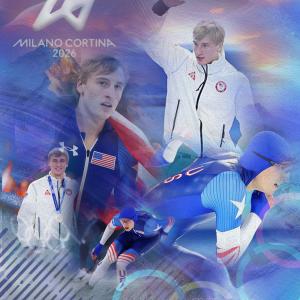
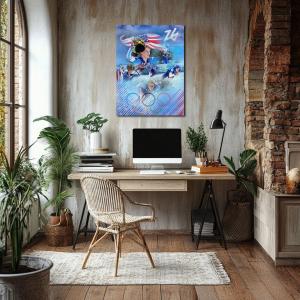
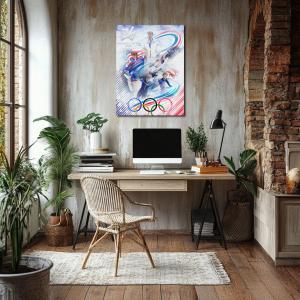
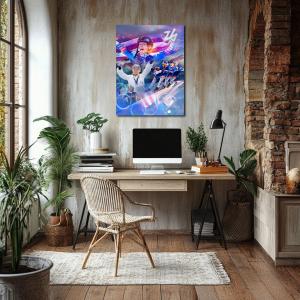
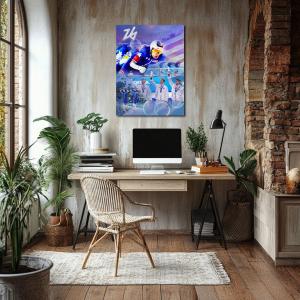
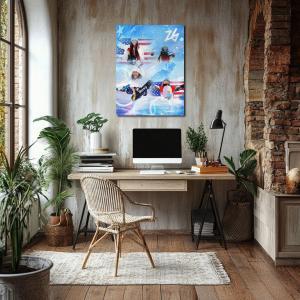
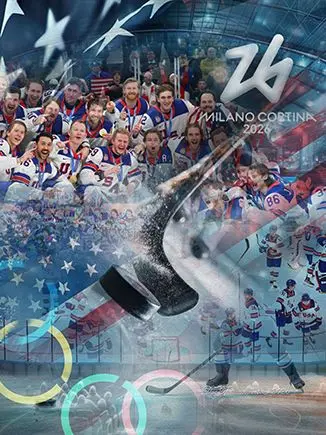
At the Milano Cortina 2026 Winter Olympics, the United States Men’s Ice Hockey Team won gold with a 2–1 overtime victory over Canada. Jack Hughes scored the decisive goal 1:41 into OT , after Matt Boldy opened scoring and Cale Makar equalized. Goaltender Connor Hellebuyck recorded 41 saves on 42 shots . Rendered in cerulean ice, titanium white scorelines, and amber overtime light, the artwork translates the verified final — USA 2–1 (OT) — into a precise and luminous portrait of Olympic triumph.
Please see Below for Details…


Hotline Order:
Mon - Fri: 07AM - 06PM
019-234-09789
Inside the vaulted steel and glass of the Milano Santagiulia Ice Hockey Arena at the XXV Olympic Winter Games — Milano Cortina 2026, the United States Men’s Ice Hockey Team authored a final that reduced four years of preparation to a single luminous equation: USA 2 – Canada 1 (Overtime). As the artist, I do not paint this as a celebration alone; I render it as a ledger of verified fact and kinetic design. The gold medal was decided in sudden death, 1:41 into overtime, when Jack Hughes released the decisive shot that severed regulation symmetry and inscribed “2–1 OT” into the official Olympic record. Before that strike, the contest unfolded as a study in balance and fracture — Matt Boldy opening the scoring for the United States, Cale Makar equalizing for Canada — and then the geometry of goaltending holding the axis steady. The numbers are exact and unambiguous: final score 2–1 (OT); Hughes’ winner at 1:41 of sudden death; and Connor Hellebuyck’s 41 saves on 42 shots, the defensive architecture that preserved possibility until the final vector found net.
Unlike judged sports, Olympic ice hockey is not resolved by TES, PCS, or placement points. There are no program components, no element sheets, no deductions columns. The scoring grammar here is elemental: goals, assists, saves, penalties, and time. The absence of judged arithmetic is itself part of the composition. Where figure skating displays columns of numbers, hockey presents a stark scoreboard — white numerals against midnight ice — and that minimalism is its own aesthetic. In my painting, the scoreboard becomes a monolith of titanium white: 2–1 (OT) set in clean, decisive type, the “OT” rendered in amber to signal that the final required the crucible beyond regulation.
Context is the underpainting. Team USA arrived at the medal round through a disciplined preliminary ascent — undefeated in group play, advancing with momentum through the elimination bracket, and carrying into the final the accumulated force of prior victories. Those earlier results are not clutter; they are brushstrokes beneath the surface, a faint lattice of trajectories guiding the eye toward the championship moment. Yet the final remains the fulcrum. Regulation closed at 1–1, a mirror image of tension where each side had tested the other’s structure. The overtime clock began its short, electric count, and at 1:41, Hughes’ release transformed parity into permanence.
Color must carry the physics. The ice is cerulean and surgical, a plane held near winter hardness, reflecting arena light in fractured bands of sapphire. The American crest blooms in red and white across jerseys and flag — red for anaerobic ignition in the corners, white for the crisp edge of the crease. Canada’s equalizer is a brief flare of vermilion, a controlled rupture in momentum that I place as a diagonal slash through the middle register. Hellebuyck’s crease becomes a sanctuary of cobalt and graphite; 41 saves are not a statistic alone but a spiral of deflections, glove flashes, pad kicks, and stick angles that I suggest with concentric arcs, as if each stop were a ring expanding outward from the blue paint. Forty-one times, geometry prevailed; once, it did not — and that solitary Canadian tally is balanced by the American pair.
The puck itself is the narrative nucleus. In overtime, its path becomes a comet — amber at the core, edged with white — cutting across a field of frozen blue. The instant of Hughes’ release is rendered with tensile clarity: stick flex captured in a thin silver curve, the blade’s contact point a spark against the ice. The net, in that fraction of a second, is less mesh than portal. When the puck crosses the line, the composition tilts upward. The top third floods with warm gold light — not ostentatious, but structural — because gold here is earned through time and resistance. The crowd dissolves into a mosaic of indigo and navy, an atmospheric chorus, while the foreground figures explode into diagonals of motion — gloves thrown skyward, knees bending into the ice in cathartic release.
Hockey’s protocol is austere but definitive. The official result reads simply: United States 2, Canada 1 (OT). The golden goal occurred at 1:41 of overtime. Hellebuyck recorded 41 saves on 42 shots. These are the numbers that anchor the canvas. There are no placement points to convert, no component factors to multiply. The medal color is determined by the final whistle and the net’s surrender. The United States Men’s Team — Gold Medalists.
Yet the austerity does not diminish complexity. Every shift is a vector; every line change a recalibration. The rink’s geometry — two blue lines, a red center line, circles and hash marks — becomes a cartography of risk. I emphasize these with faint, luminous tracings, suggesting how space was negotiated and reclaimed. The neutral zone appears as a corridor of tempered steel; the offensive zone as a chamber of heat. In the crease, the goalie’s silhouette is sculpted in cool light, a statue of reaction and anticipation. Hellebuyck’s 41 saves I scatter as spectral imprints behind him — ghost pucks suspended in the air, each one a memory of danger turned aside.
The overtime marker is critical. “OT” is more than abbreviation; it is a threshold. In my palette, it glows in restrained amber — the color of decisive heat in a frozen arena. The clock at 1:41 is a small, exacting detail — a timestamp that compresses eternity into seconds. I place it near the upper right, as if time itself were pinned to the rafters. Beneath it, Hughes’ form is captured at full extension, blade angled, weight transferred — the physics of the shot implied by the curvature of the stick and the direction of the spray. Boldy’s earlier goal appears as a softer echo in the midground — a reminder that openings matter, that first strikes shape finales. Makar’s equalizer is rendered as a cool counterpoint, a balanced chord before the final crescendo.
The Olympic rings sit low in the frame, refracting arena light into their distinct hues. They are not mere emblem but resonance — a reminder that this contest unfolded within a global amphitheater. The rings’ blue and green harmonize with the ice; the red and yellow catch in the jerseys; the black anchors the composition. Around them, frost-textured strokes suggest breath in winter air — the human element in a mechanical game.
In the aftermath, the numbers remain. 2–1 (OT). 1:41. 41 saves on 42 shots. These are not decorative; they are documentary. They belong to the archive and to the art. If I were to inscribe a single line beneath the painting, it would be the equation of the night: regulation stalemate, sudden-death release, defensive constancy, and a nation’s ascent. The gold medal is the visible artifact; the arithmetic is the invisible scaffolding.
The image resolves in layered light. Cerulean ice steadies the base; titanium white carves the scoreboard; crimson pulses through the fabric; amber ignites the overtime; graphite shadows cradle the crease. The United States Men’s Ice Hockey Team stands within this spectrum as measured victors. The music of the arena fades, but the figures hold — sticks raised, gloves lifted, a goalie exhaling after forty-one acts of refusal.
This is how I paint verified triumph: not as abstraction, but as protocol made luminous. The final is exact. The time is exact. The saves are exact. And within those exactitudes, the winter burns gold.
Add your review
Your email address will not be published. Required fields are marked *
Please login to write review!
Looks like there are no reviews yet.