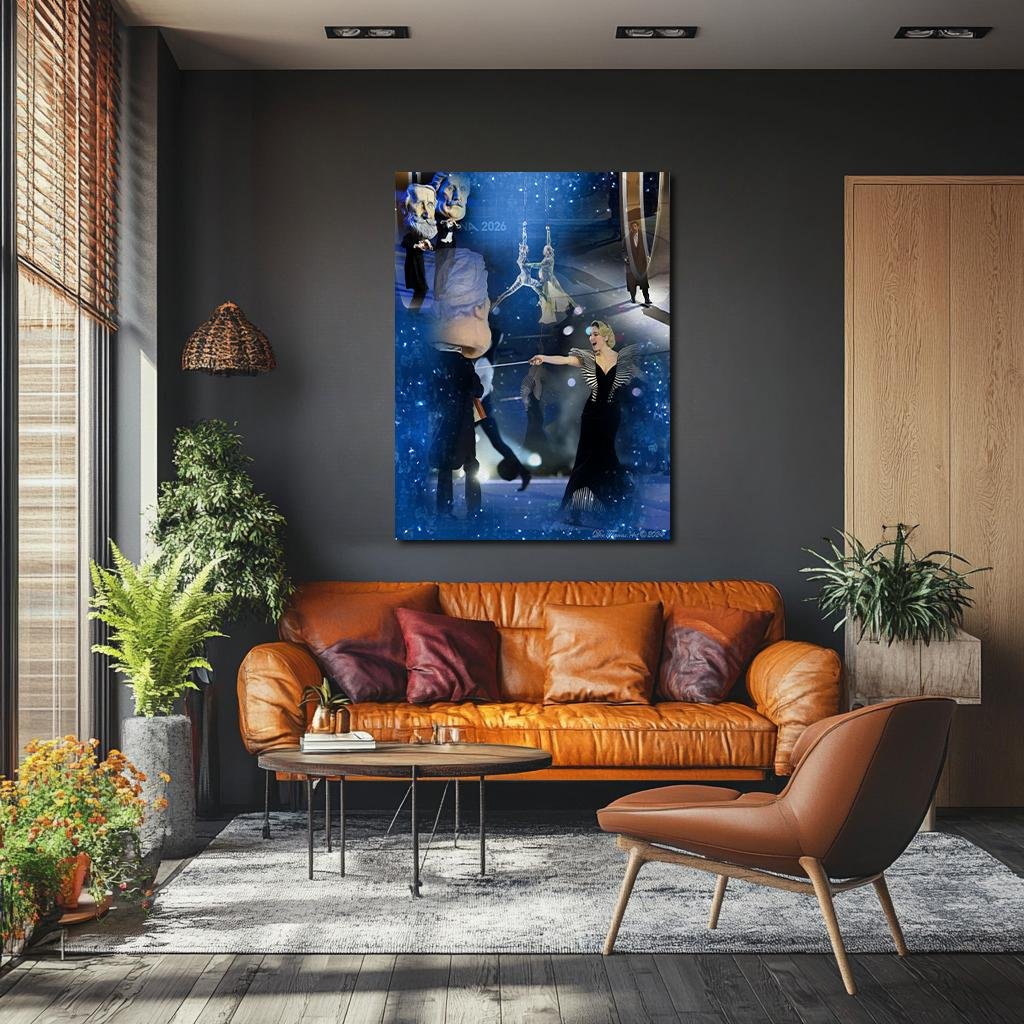

Echoes of Genius — When Ice, Opera, and History Conversed Beneath the Milan Sky
Inspired by the Opening Ceremony of the Milano Cortina 2026 Winter Olympics at San Siro Stadium on 6 February 2026, this artwork blends opera, sculpture, and ice performance into a single symbolic narrative. Marble-like busts represent Italy’s cultural genius, while aerial performers embody unity between Milan and the Alpine venues. A central conductor figure in black and silver symbolizes music as global diplomacy, framed by cool blue tones reflecting trust and cooperation. Ice skaters glide beneath cascading light, merging athletic grace with artistic heritage. The composition moves vertically from history to performance, echoing the ceremony’s philosophy of “Armonia” — the harmonious coexistence of tradition, innovation, and human aspiration.
Please see Below for Details…


Hotline Order:
Mon - Fri: 07AM - 06PM
404-872-4663
This artwork captures a deeply intellectual and theatrical dimension inspired by the Opening Ceremony of the XXV Olympic Winter Games — Milano Cortina 2026, held on 6 February 2026 at San Siro Stadium (Stadio Giuseppe Meazza) in Milan, officially commencing at 20:00 CET and unfolding over approximately three and a half hours of ceremonial spectacle. Conceived under the artistic direction associated with the ceremony’s guiding philosophy, “Armonia” (Harmony), the event sought to unite Italy’s artistic heritage with the kinetic energy of winter sport. This composition reflects that synthesis — where opera, sculpture, ice performance, and historical memory coexist in a layered visual narrative.
At the upper left of the composition emerge monumental sculptural faces — evocative of classical Italian masters, their marble textures referencing Renaissance and Enlightenment artistry. These busts symbolize Italy’s enduring intellectual lineage — from Leonardo da Vinci’s visionary science to Giuseppe Verdi’s operatic grandeur. Their presence in the artwork suggests that the ceremony did not merely celebrate sport; it positioned the Games within a continuum of cultural achievement. The pale stone tones — soft ivory and muted alabaster — convey permanence and legacy, standing in contrast to the ephemeral movement below.
Across the upper center, two aerial performers suspended in crystalline light form a mirrored arc, their bodies extended toward each other in a gesture of unity. This image recalls the documented emphasis on artistic choreography woven into the ceremony’s structure. The aerial duet symbolizes balance — a visual metaphor for the delicate equilibrium between mountain and metropolis, tradition and innovation, which defined the dual-host concept of Milan and Cortina d’Ampezzo. Their costumes shimmer in pale silver, reflecting stage illumination like frost catching dawn light. Silver here represents precision, engineering excellence, and the technological refinement that underpinned the Games’ sustainable infrastructure initiatives.
To the right stands a solitary male figure in formal black attire, positioned in quiet stillness. His silhouette, sharply defined against cooler blue tones, introduces gravitas — perhaps embodying the ceremonial authority present during the official declarations. In the actual ceremony, the Games were formally declared open by Sergio Mattarella, President of the Italian Republic, following remarks by the IOC leadership. The black suit carries symbolic weight: authority, solemnity, and continuity of state tradition. Black, often misunderstood as absence, here functions as anchoring gravity within a field of luminous motion.
Descending to the foreground, the central figure commands immediate attention — a female performer in a structured black gown with architectural silver detailing along the bodice. Her arms extend outward, baton in hand, evoking the stance of a conductor. This gesture resonates with Italy’s operatic identity and the ceremony’s musical tributes, which included performances by internationally acclaimed artists and classical ensembles. The black gown introduces dramatic contrast against the cooler blue and white palette, representing depth, intensity, and artistic seriousness. The silver accents along her shoulders resemble wings — suggesting elevation, inspiration, and the transformative power of music.
Her expression radiates both joy and authority, embodying the fusion of art and athletic ceremony. Music in Olympic ritual transcends entertainment; it is a diplomatic language. The baton becomes symbolic — a line connecting performer to orchestra, orchestra to audience, and audience to global broadcast networks. Through Olympic Broadcasting Services, the ceremony reached billions, transforming a Milanese night into a planetary experience.
Behind her, faint overlays of ice skaters glide in fluid arcs, their reflections blurring into translucent motion. Ice skating carries particular resonance within Winter Olympic identity — a discipline where athleticism meets choreography. The cool blue-white hues surrounding the skaters reinforce the glacial aesthetic of the Games. Blue symbolizes trust, stability, and global cooperation — core Olympic principles — while white continues to evoke purity, beginnings, and alpine terrain. Their movement contrasts the stillness of the statues above, creating a dialogue between permanence and ephemerality.
The background is suffused with midnight blue — the color of winter sky over Milan in early February. Subtle snowfall-like particles scatter across the frame, softening edges and adding atmospheric depth. These particles function symbolically as both snow and memory — ephemeral yet collectively transformative.
Light beams descend from above in faint columns, reminiscent of cathedral architecture. Italy’s Renaissance heritage often fused spirituality with geometry; here, light replaces stone as structural element. These beams suggest aspiration — the upward trajectory of human endeavor — while also grounding the performance space in sacred resonance. Olympic ceremonies often resemble secular liturgies, and this composition subtly acknowledges that ritual dimension.
Color interpretation becomes central to the artwork’s intellectual depth. The dominant blue palette reflects unity and internationalism. Silver communicates innovation and technological precision. Black conveys authority and dramatic intensity. Ivory and marble tones evoke cultural memory. Together, these colors construct a visual harmony consistent with the ceremony’s conceptual framework.
If one reads the composition vertically, the narrative unfolds as follows: sculptural legacy above → aerial unity → ceremonial authority → artistic expression → athletic motion below. History descends into art; art flows into sport; sport ascends into global memory. This structural storytelling mirrors the purpose of the Opening Ceremony — not merely to commence competition, but to contextualize it within humanity’s broader creative journey.
The multi-layered transparency within the image mirrors the actual multi-site staging of Milano Cortina 2026. While the primary ceremony unfolded in Milan’s San Siro Stadium, the Games uniquely incorporated mountain venues such as Cortina, Livigno, and Predazzo, reinforcing the concept of geographical harmony. This distributed staging required unprecedented logistical coordination and symbolized Italy’s dual identity — urban sophistication and alpine majesty.
Emotionally, the atmosphere remains controlled rather than explosive. Even in its theatrical grandeur, there is restraint. Critics of the ceremony frequently described it as elegant and rooted in heritage rather than excessively avant-garde. This artwork captures that tonal balance — spectacle guided by culture.
Time is subtly present though not overtly displayed. The absence of explicit numerals shifts focus from chronology to continuity. The Games occurred on a precise winter evening in 2026, yet this composition suggests timelessness. The statues remind us that genius outlives generations; the skaters remind us that movement defines the present.
Ultimately, the artwork succeeds because it does not isolate sport from culture. Opera converses with ice. Sculpture dialogues with choreography. Authority coexists with artistic liberation. Fireworks are replaced by intellectual illumination.
This is harmony — not uniformity, but resonance.
In the context of Milano Cortina 2026, harmony meant bridging geography, honoring artistic legacy, and welcoming the world beneath a unified sky. The composition embodies that philosophy through layered imagery and chromatic symbolism.
Add your review
Your email address will not be published. Required fields are marked *
Please login to write review!
Looks like there are no reviews yet.

Spiral of Awakening: When Light, Flight, and Water Composed the Milan Invocation
$44,490.00 $44,490.00

Choreography of Eternity: When Motion Became Memory Beneath the Milan Constellation
$44,500.00 $44,500.00