
Chromatic Aria — When Color Learned to Sing Beneath the Winter Sky
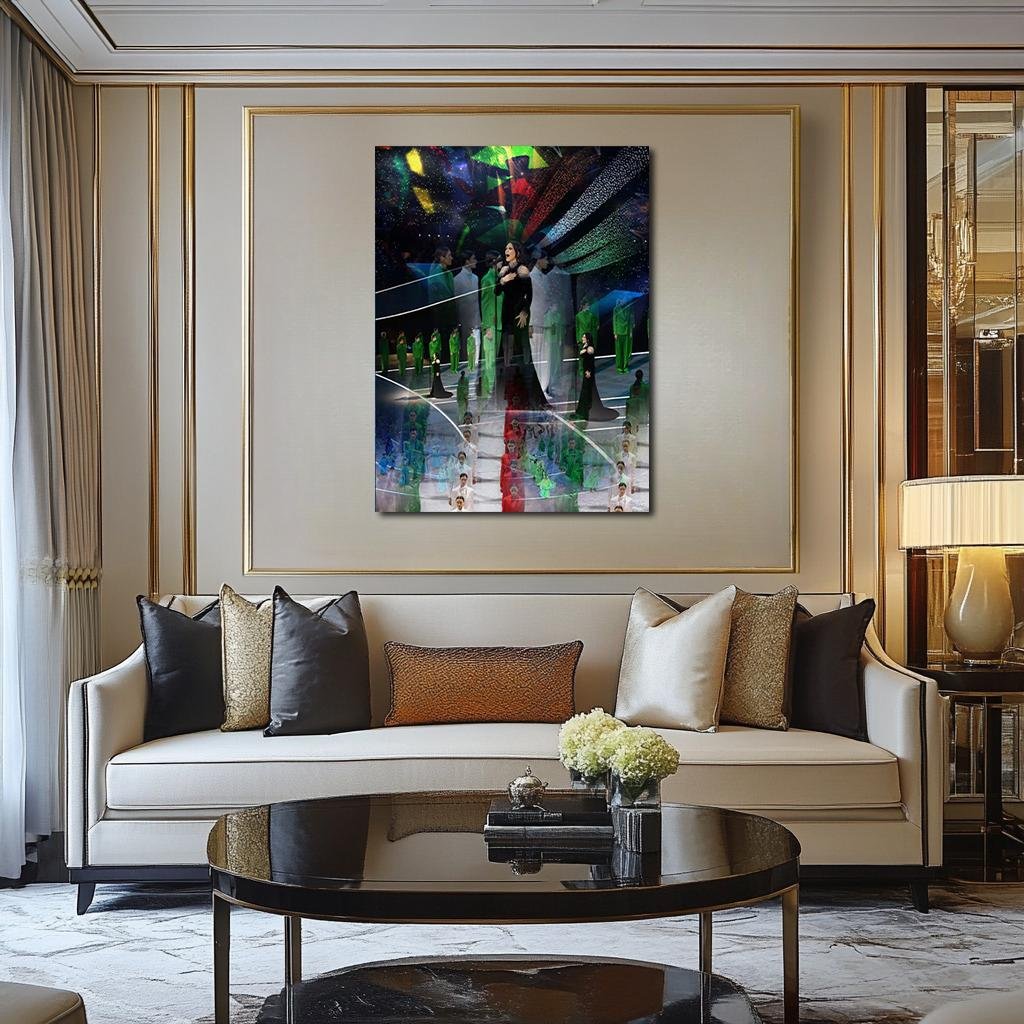
Inspired by the Opening Ceremony of the Milano Cortina 2026 Winter Olympics at San Siro Stadium on 6 February 2026, this artwork transforms a global spectacle into a radiant meditation on unity through color and music. A central vocalist in a sculptural black gown symbolizes emotional depth, while formations of green, white, and red performers echo vitality, purity, and courage. Above them, prismatic lights expand into a cosmic canopy representing diversity among nations. Architectural stage lines suggest discipline, contrasting with the organic brilliance of color. Rooted in the philosophy of “Armonia,” the composition rises from human presence toward luminous infinity, reminding us that the Olympics are not merely competitions, but shared expressions of aspiration, continuity, and collective hope.
Please see Below for Details…


Hotline Order:
Mon - Fri: 07AM - 06PM
404-872-4663
This artwork captures a vibrant ceremonial moment inspired by the Opening Ceremony of the XXV Olympic Winter Games — Milano Cortina 2026, held on 6 February 2026 at San Siro Stadium (Stadio Giuseppe Meazza) in Milan, where the global celebration officially commenced at approximately 20:00 Central European Time. Broadcast worldwide through Olympic Broadcasting Services and witnessed by billions, the ceremony unfolded as a carefully orchestrated theatrical experience rooted in the guiding philosophy of “Armonia” — Harmony, a concept designed to unite humanity, landscape, tradition, and innovation. Within this composition, the ceremony is transformed into a luminous field of symbolic color and emotional resonance, where music, choreography, and visual architecture converge into a single living canvas.
At the highest visual register, shards of radiant color burst across a cosmic darkness — emerald greens, solar yellows, deep blues, and flashes of crimson appearing almost like refracted auroras suspended above the stadium. These luminous fragments evoke the authentic lighting design used during the ceremony, where projection and chromatic beams expanded the stadium ceiling into an illusion of infinity. The colors feel intentionally prismatic, recalling the Olympic principle of global diversity. Rather than merging into a singular hue, they coexist — an artistic metaphor for nations gathering without surrendering identity.
Green dominates the upper spectrum, immediately grounding the artwork in a chromatic language of renewal, vitality, and ecological awareness. Milano Cortina placed strong emphasis on sustainability — from infrastructure planning to energy-conscious staging — and the prominence of green visually echoes that forward-looking environmental responsibility. Yellow punctuates the darkness like intellectual sunlight, symbolizing optimism and the awakening of possibility that accompanies every Olympic beginning. Blue stabilizes the palette, historically associated with trust, diplomacy, and international cooperation — core values embedded within the Olympic Charter since its modern revival.
At the compositional center stands the principal vocalist, dressed in a sculptural black gown that absorbs surrounding light while simultaneously defining the visual axis of the artwork. Black here is not emptiness but depth — the color of theatrical authority and emotional gravity. Against the surrounding chromatic brilliance, the gown becomes a stage unto itself, allowing the performer’s gesture to radiate with clarity. Her hand rests over her heart, a posture universally read as sincerity and emotional offering. In that moment she becomes less an entertainer and more a ceremonial emissary — channeling the tradition of live musical performance that has long shaped Olympic openings.
The microphone before her functions symbolically as a modern torch. Where flame historically marked the beginning of the Games, amplified voice now carries emotional ignition across continents. Music in Olympic ritual is diplomacy without translation — capable of reaching cultures simultaneously. Her upward gaze suggests not performance but invocation, as though summoning the collective memory of the world into the present night.
Around her appear layered exposures of the same figure, subtly repeated across the stage. This visual multiplicity mirrors the ceremony’s multi-location identity, connecting Milan with Alpine venues such as Cortina d’Ampezzo, Livigno, and Predazzo. The repetition becomes philosophical — one voice traveling across mountains, valleys, and urban skylines, reminding us that modern ceremonies unfold simultaneously in physical and broadcast space.
Encircling the vocalist is a disciplined formation of performers dressed in vivid green. Their arrangement introduces architectural symmetry reminiscent of Italian piazzas, where geometry organizes public life. Green garments symbolize growth and collective momentum — appropriate for athletes whose journeys represent years of cultivation. Yet the tone of green is neither muted nor militaristic; it is alive, suggesting humanity in forward motion.
Interspersed among them stand performers clothed in pure white, their presence introducing visual breath within the chromatic density. White, in the context of the Winter Games, inevitably evokes alpine snow — untouched terrain awaiting athletic inscription. Symbolically, it speaks of beginnings, neutrality, and shared ground upon which nations compete without conflict.
Toward the lower register, a river of red garments emerges, grounding the composition with visceral energy. Red is the color of pulse, endurance, and courage — the physiological truth behind every athletic achievement. Positioned beneath cooler hues, it functions almost like a heartbeat supporting the entire structure.
Light itself becomes a central architectural force within the artwork. Clean white lines sweep across the stadium floor, curving gently like orbital paths. These lines guide the eye while symbolizing trajectory — the disciplined pathways athletes follow toward excellence. Their geometry contrasts beautifully with the organic dispersion of color above, illustrating the equilibrium between structure and imagination that elite sport demands.
The stage floor appears expansive, nearly horizonless, dissolving boundaries between performer and space. This openness reflects the literal scale of San Siro, one of Europe’s most historic stadiums, temporarily transformed from a cathedral of football into a global amphitheater of winter celebration. The conversion itself was symbolic — demonstrating how spaces can evolve while retaining cultural memory.
Atmospherically, the artwork radiates controlled grandeur. Despite saturated color and layered imagery, it avoids chaos. Critics of the ceremony often noted its elegance — spectacle guided by artistic discipline rather than sensory excess — and this composition captures that restraint.
If one reads the image vertically, a narrative unfolds: grounded performers → ascending vocalist → chromatic sky. Humanity rises toward expression; expression rises toward unity; unity dissolves into the cosmos. Such vertical storytelling mirrors the deeper purpose of an Opening Ceremony — transforming a scheduled sporting event into a mythic threshold between eras.
Time, though invisible, permeates the scene. The ceremony occurred on a precise winter evening in early February 2026, yet the emotional language suggests permanence. Olympic moments are paradoxical — fleeting in duration yet enduring in collective consciousness.
Emotionally, the artwork vibrates with sincerity. There is no irony here, no detachment. Instead, one senses invitation — a host nation opening its cultural heart to the world. The performer’s gesture reinforces this: hand to chest, voice outward.
Ultimately, the composition succeeds because nothing exists in isolation. Color belongs to identity. Music belongs to humanity. Geometry belongs to discipline. Light belongs to hope.
This is harmony — not uniformity, but coexistence.
Exactly the philosophical center envisioned for Milano Cortina 2026, where mountains and metropolis, tradition and progress, gathered beneath a single winter sky.
Add your review
Your email address will not be published. Required fields are marked *
Please login to write review!
Looks like there are no reviews yet.