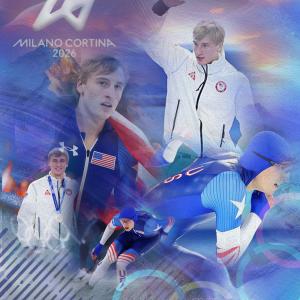


Blades of Light and Measured Air: Alysa Liu’s Structural Contribution to Olympic Gold at Milano Cortina 2026
At the Milano Ice Skating Arena during the 2026 Winter Olympics , Alysa Liu delivered a Women’s Short Program score of 74.90 , earning 9 placement points in the Figure Skating Team Event. Competing within the eight-segment team format, her second-place finish in the segment contributed directly to Team USA’s cumulative total that secured Olympic Gold . At just 20 years old, Liu’s performance combined technical precision, compositional clarity, and psychological composure, transforming one precisely executed short program into a decisive structural element of American Olympic victory.
Please see Below for Details…


Hotline Order:
Mon - Fri: 07AM - 06PM
019-234-09789
Under the vaulting lights of the Milano Ice Skating Arena, at the XXV Olympic Winter Games — Milano Cortina 2026, Alysa Liu entered Olympic ice not merely as an individual competitor but as a structural pillar within the United States’ Figure Skating Team Event architecture. On the opening segment of the Team competition, she delivered a Women’s Short Program score of 74.90, earning 9 placement points toward Team USA’s cumulative total — a quantified contribution that would help secure Olympic Team Gold. In the mathematics of figure skating’s team format, those 9 points are not symbolic. They are arithmetic components within an eight-segment matrix that determines medal color through cumulative placement scoring.
The Figure Skating Team Event consists of eight total segments across four disciplines: Men’s Short Program, Men’s Free Skate, Women’s Short Program, Women’s Free Skate, Pairs Short Program, Pairs Free Skate, Rhythm Dance, and Free Dance. Placement in each segment awards points on a descending scale — 10 for first, 9 for second, 8 for third, and so forth — with the aggregate total determining final standings. Liu’s 74.90 in the Women’s Short Program secured second place in that segment, earning the United States 9 critical placement points at the outset of the team competition. In Olympic team scoring architecture, early stabilization is decisive; an initial high placement reduces cumulative deficit exposure across subsequent segments.
Born August 8, 2005, in Clovis, California, Alysa Liu arrived at Milano Cortina 2026 at 20 years of age, carrying with her a trajectory that had already traversed U.S. national championships and international podiums. Her skating identity has long been defined by technical ambition combined with compositional fluency — a balance between jump base value accumulation and program component execution. At the Olympic Games, however, individual ambition must yield to team calculus. Liu’s 74.90 was not chased recklessly for maximal base value; it was calibrated for stability, execution quality, and placement security within the Team Event’s broader scoring geometry.
The Women’s Short Program in Olympic competition demands execution of specific required elements: a solo jump, a jump combination, three spins of designated positions, a step sequence, and choreographic continuity aligned to music interpretation. Technical Element Score (TES) and Program Component Score (PCS) converge to form the segment total. Liu’s 74.90 emerged from this convergence — each spin rotation, each step edge, each landing under-rotation check feeding into the ISU judging panel’s evaluation grid. In Olympic scoring, Grade of Execution (GOE) modifiers applied to each element refine the final number; negative GOE deductions can erode placement, while positive increments accumulate fractional advantage. The final score therefore represents not only successful element completion but clean execution margins.
Within the Team Event, Liu was substituted for the Free Skate segment according to Olympic regulations permitting lineup adjustments after the Short Program. This strategic substitution underscores the team-oriented design of the event: nations optimize athlete deployment to maximize cumulative points across disciplines. Her singular segment performance, therefore, stands independently as a structural contribution — 74.90 → 9 points → integrated into Team USA’s final gold total. Without that near-top placement, the margin for overall team victory compresses significantly.
In artistic rendering, Liu’s Olympic moment unfolds in layered exposure: the poised glide before the opening pose, the rotational lift of a triple jump’s takeoff, the blade carve across ice during step sequence articulation, and finally the podium moment draped in the American flag. Each layer represents a phase within a tightly controlled 2-minute 40-second Short Program window — the maximum permitted duration under ISU regulations for women’s short programs. Time, here, is not elastic. It is fixed. Within that span, every transition must align with musical phrasing and scoring constraints.
Color within the composition mirrors competitive architecture. Deep cobalt blues evoke the cool discipline of Olympic ice — a surface maintained at precise sub-freezing temperature to preserve blade bite and spin stability. White tonal gradients represent compositional clarity and rotational symmetry. Crimson accents derived from Team USA insignia signify controlled intensity — the emotional current required to transform technical precision into performance resonance. Above all, gold illumination radiates not as personal triumph alone but as cumulative team outcome: Liu’s 9 placement points refracted through the total that elevated the United States to the top of the podium.
The physics of figure skating underpin the aesthetic. Angular momentum generated during jump takeoff must be conserved through air rotation before controlled deceleration on landing. Spin revolutions require vertical axis stability, core engagement, and friction management between blade and ice. In step sequences, edge depth and knee articulation determine glide efficiency and component evaluation under the “Skating Skills” criterion. Liu’s Olympic Short Program exhibited control across these mechanical dimensions, preventing under-rotation penalties and maintaining rotational clarity. That mechanical discipline translated directly into the 74.90 posted on the official scoreboard.
Within the Team Event chronology, her segment occurred early in competition sequence. Early segments shape psychological momentum: a strong second-place finish establishes confidence and scoreboard leverage. In placement arithmetic, every point preserved early reduces reliance on later segments for recovery. The United States’ eventual Team Gold therefore rests partially on the stability provided by Liu’s performance. Her contribution aligns numerically with teammates across disciplines — ice dance placement points, men’s segment totals, pairs contributions — forming a cohesive competitive ledger.
Psychologically, Olympic ice compresses expectation and execution into a singular exposure window. Unlike multi-day championships where rhythm builds gradually, the Team Event Short Program presents immediate consequence. Liu’s composure under that compression — delivering a 74.90 score sufficient for 9 placement points — reflects elite mental conditioning. The absence of major execution deductions in her segment ensured that base value and component accumulation translated cleanly into final score.
From a historical standpoint, the 2026 Team Gold extends the United States’ presence in Olympic figure skating team competition. Liu’s role situates her within a lineage of American women whose Olympic contributions blend technical ambition with compositional integrity. At 20 years old during Milano Cortina, her Olympic appearance bridges generational evolution — from early prodigy status to mature competitor integrated within team strategy.
In compositional symbolism, the Olympic rings beneath the ice in the artwork mirror the concentric evaluation layers of figure skating scoring — Technical Elements, Program Components, GOE modifiers, placement points. Each ring intersects with others, as each segment intersects with cumulative team outcome. The “26” insignia above the composition marks the temporal coordinate — Milano Cortina 2026 — situating Liu’s performance within Olympic chronology.
Mathematically, the significance is simple yet profound: 74.90 points → 9 placement points → integrated into 8-segment team total → Olympic Gold. Those numbers form the skeleton beneath the artistic skin. They are the structural constants behind the choreography. In elite sport, especially figure skating, fractions determine placement. A tenth of a point in GOE, a quarter rotation in jump takeoff, a minor step-out on landing — each can recalibrate podium outcome. Liu’s clean execution preserved those fractions in favor of Team USA.
The visual narrative captures her not as isolated performer but as kinetic contributor within a synchronized national effort. Her blade etches arcs across ice; those arcs become vectors of national advancement. Her smile on the podium reflects collective success rather than solitary achievement. In the language of Olympic structure, she is both individual skater and integral variable within a larger equation.
Ultimately, Alysa Liu’s Olympic story at Milano Cortina 2026 is one of precision integrated into unity. The Women’s Short Program score of 74.90 stands as recorded fact. The 9 placement points derived from it are immutable. Together, they contributed to an Olympic Gold that will endure in official archives long after the ice surface has been resurfaced and the lights dimmed.
The blades cut.
The judges calculated.
The placement points accumulated.
And through one measured program of 74.90, Alysa Liu became part of Olympic permanence.
Add your review
Your email address will not be published. Required fields are marked *
Please login to write review!
Looks like there are no reviews yet.